A 2,500-year-old warrior prince’s tomb in Italy still had his chariot and helmet inside
Archaeologists in Sirolo, Italy have uncovered a sixth-century BC royal burial complete with a wooden chariot, helmet and bronze vessels belonging to the ancient Piceni civilisation.
Archaeologists in Italy have uncovered the 2,500-year-old tomb of a pre-Roman warrior prince along the country’s Adriatic coast, shedding new light on the Piceni, an ancient civilisation that left behind very few written records. The royal burial was found in Sirolo, a small town on Italy’s eastern coast.
The tomb is part of a large sixth-century BC burial complex that experts believe belonged to the ruling elite of the Piceni, also known as the Picentes. The discovery was announced on July 1 by the Superintendency of Archaeology, Fine Arts and Landscape for the Provinces of Ancona, Pesaro and Urbino.
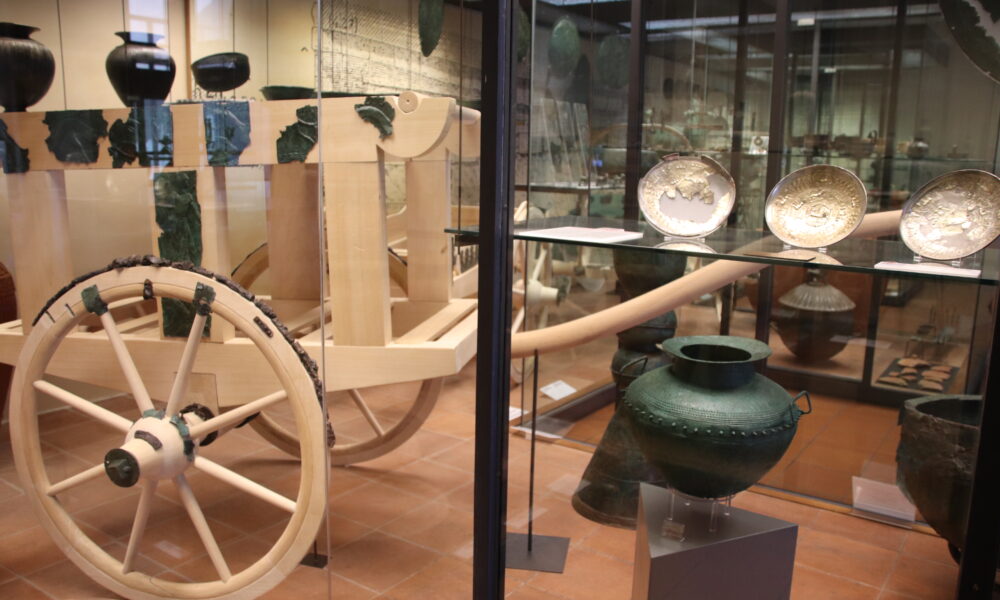
At the centre of a large circular wooden enclosure, archaeologists found the grave of an adult man buried with a wooden two-wheeled chariot, known as a currus, placed intact beside him. He was also buried with a helmet, an axe and several bronze vessels covered with ceramic lids, which researchers believe contained traces of a funeral feast or food offerings for the afterlife.
Next to the warrior prince’s grave, archaeologists uncovered the burial of a woman with textiles, shoes and several fibulae, ancient metal pins used to fasten clothing. A large fibula set with a piece of amber was found near her head, possibly part of her hairstyle or headdress. Her burial sits close to the famous Queen’s Tomb in the Pini necropolis, discovered in 1989, which held a Piceni woman buried with two chariots and two mules.
Unlike earlier Piceni burial grounds, which were typically ringed by a ditch, this cemetery was enclosed by a wooden palisade and built on a small hill, which researchers believe underscored its importance. Experts say it marks the first time archaeologists have identified an entire aristocratic nucleus of the Piceni, a people who shared their northern border with the Etruscans.


Leave a Reply