Seven storeys, carbon composite, 3D-printed engines: what makes Vikram-1 fly
Skyroot Aerospace's seven-storey Vikram-1 rocket, built with an all-carbon composite structure and 3D-printed engines, is scheduled to attempt India's first private orbital launch on Saturday.
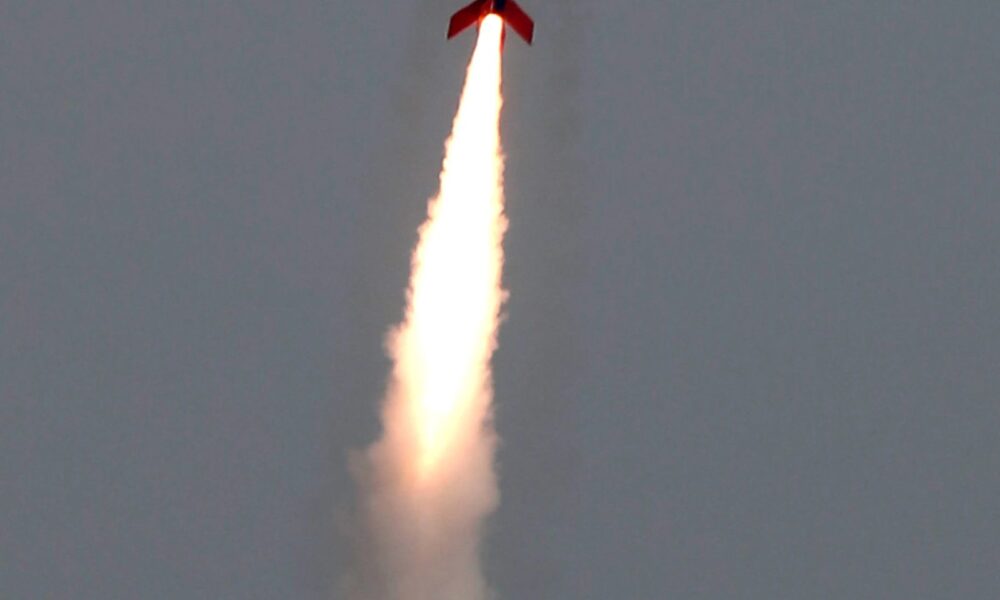
Seven storeys tall, built from an all-carbon composite structure and powered by 3D-printed engines developed in-house, Vikram-1 is set to become India’s first privately developed rocket to attempt an orbital launch. Skyroot Aerospace’s vehicle is scheduled to lift off at 11.30 am on Saturday from the first launch pad at the Satish Dhawan Space Centre-Sriharikota Range, in a mission named Aagaman.
The rocket is designed to carry satellites weighing up to 350 kg to low Earth orbit, and Saturday’s first test flight is targeting a 450 km orbit at an inclination of 60 degrees, using propulsion systems that include high-thrust solid-fuel boosters alongside the 3D-printed engines. At 22 metres tall, Vikram-1 matches the height of ISRO’s SLV-3, the four-stage experimental vehicle that placed India’s Rohini satellite RS-1 into orbit on 18 July 1980 — exactly 46 years before Saturday’s launch.
‘This is the first time a private rocket is standing on the ISRO launchpad,’ said Pawan Kumar Chandana, co-founder and CEO of Skyroot Aerospace, describing it as a significant step for the company and India’s private space sector. The launch window had earlier been set between 12 July and 4 August before being finalised for Saturday, with authorities issuing airspace and maritime notices to create restricted zones along the rocket’s ascent and impact corridor.
Skyroot’s launch control centre has completed final integrated checks on the stacked vehicle, and interface checks with telemetry ground stations and tracking radars have also been finished. Chandana said the mission is primarily about gathering data rather than a commercial launch: ‘The first test objective is to get as much data as possible on the health of all the complex systems in actual flight conditions. Till now we have been testing on the ground. This is the first time we’re testing in flight.’
The roughly 16-minute flight is expected to shape the next phase of the Vikram launch vehicle programme. Co-founder and chief operating officer Naga Bharath Daka said the mission reflects work by around 1,000 people and over 400 suppliers, adding that data from the flight would feed back into further development of the rocket.
Skyroot was founded in 2018 by Chandana and Daka, both former ISRO scientists in their late 30s, and built Vikram-1 in under four years — compared with the eight to 10 years Chandana says orbital rocket development usually takes elsewhere. The Hyderabad-based firm became India’s first spacetech unicorn in May this year, valued at over $1.1 billion after a $60 million fundraise led by GIC and Sherpalo Ventures, and had earlier flown its suborbital Vikram-S rocket successfully on 18 November 2022.
Wikimedia Commons/by ISRO



Leave a Reply