This Giraffe Study Just Rewrote What We Know About Animal Smarts
New research shows giraffes can mentally add hidden quantities of food to pick a larger total, challenging assumptions that big brains are needed for such skills.
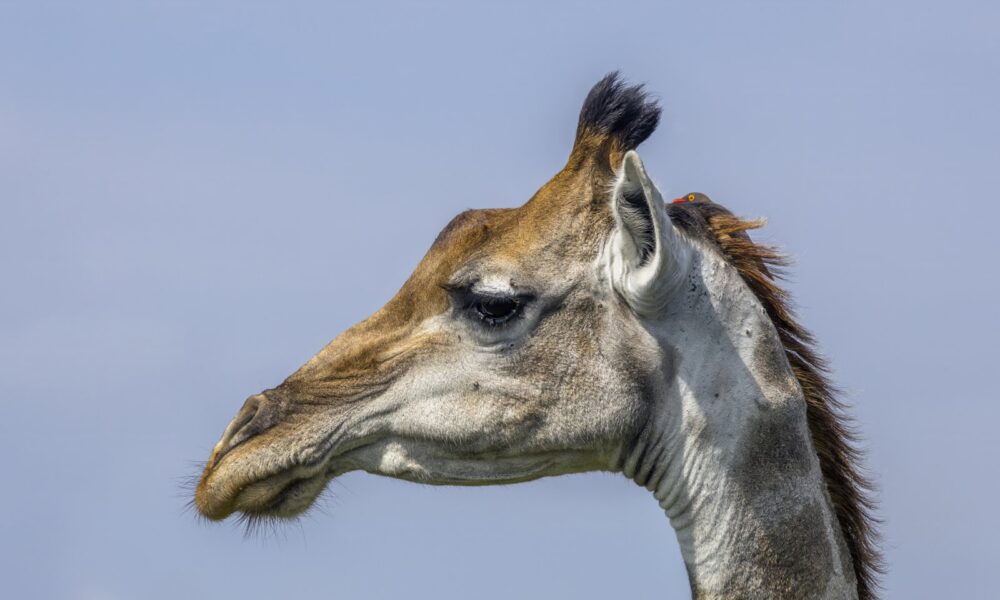
For decades, scientists linked complex mental skills like arithmetic to animals with large brains relative to their body size, think primates, dolphins, and parrots. A new study in ‘Scientific Reports’ complicates that picture. Researchers from the University of Barcelona and the University of Leipzig found that giraffes, despite having comparatively small brains for their body size, can mentally add hidden quantities of food well enough to reliably choose the larger total.
The team tested four giraffes at Barcelona Zoo, named Nakuru, Njano, Nuru and Yalinga. Researchers placed carrot pieces into two covered containers within the giraffe’s view, sealed the lids, then poured additional carrots from a third container into one of the sealed ones. To choose correctly, each giraffe had to remember the starting amounts, mentally combine the new pieces with the hidden total, and select the container holding more, without ever seeing a direct comparison.
The giraffes succeeded at this addition task around 68% of the time, tracking totals up to five items and mentally adding as many as three new pieces at once. Subtraction, however, proved far more difficult. When researchers instead visibly removed carrots from a container, giraffe accuracy dropped to about 57%, close to the level of random guessing.
That pattern, addition mastered before subtraction, echoes findings in human children and in earlier primate studies, including chimpanzees, which also perform better at combining quantities than at handling removal.
Researchers guarded carefully against the Clever Hans effect, in which an animal appears to solve a task simply by reading a trainer’s body language. The experimenter wore sunglasses and maintained a neutral expression during every trial. When hand gestures were used to try to steer the giraffes toward an incorrect container, two of them, Nuru and Njano, still selected the container with the true larger total, indicating genuine mental tracking rather than cue-following.
The researchers suggest the giraffe’s social and feeding habits, moving through constantly shifting herds and judging which distant trees hold more leaves, may be a more likely driver of this numerical ability than brain size alone, pointing to socio-ecological pressure as an underrated route to animal intelligence.
Wikimedia Commons/by Charles J. Sharp


Leave a Reply