Scientists reveal why this spider’s silk survives what Kevlar can’t
A study of Darwin's bark spider's silk shows it is more than 10 times tougher than Kevlar because it stays flexible under stress instead of snapping.
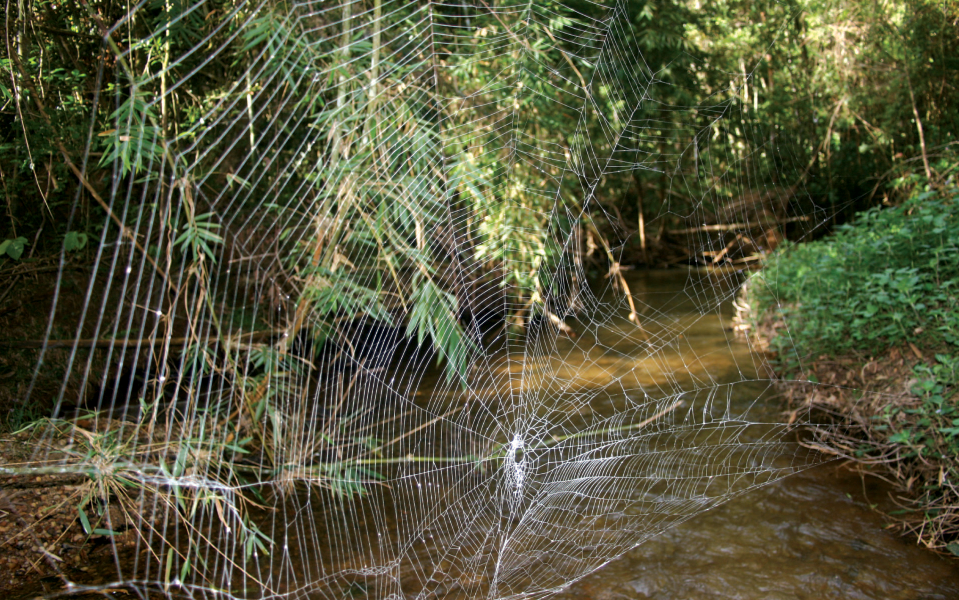
Kevlar is prized for stopping bullets, but according to researchers, it still falls well short of a material spun by a spider barely the size of a fingernail. Darwin’s bark spider (Caerostris darwini), found in the rainforests of Madagascar, produces silk that scientists have identified as the toughest biological material ever studied — a discovery that has drawn biologists, engineers and materials scientists into studying it for future synthetic fibres.
Research led by Dr Ingi Agnarsson of the University of Puerto Rico and Dr Matjaž Kuntner of the Scientific Research Centre of the Slovenian Academy of Sciences and Arts found that the spider’s dragline silk has an average toughness of around 350 megajoules per cubic metre, with some samples reaching as high as 520 MJ/m³. That makes it more than twice as tough as any other spider silk studied so far, and more than 10 times tougher than Kevlar of a comparable size — the same synthetic fibre widely used in body armour.
The spider needs that toughness because of how it lives. Discovered in Madagascar in 2009, it builds its home in an unusual way: instead of stringing a web between nearby branches like most spiders, it stretches a single bridge line across open water first, then constructs the rest of the web on top of it. According to Keio University, that anchor thread can span up to 25 metres, and the finished sticky orb can cover as much as 2.8 square metres, making it the largest known web ever built by a single spider — one that has to survive wind, rain and the impact of fast-flying insects without tearing apart.
A 2021 review published on PubMed explains the underlying reason the silk performs so well: it combines high tensile strength with exceptional extensibility, giving it the ability to absorb energy before breaking rather than snapping suddenly, unlike most synthetic materials, which tend to be either strong or flexible but rarely both.
A study led by Markus J. Buehler at the Massachusetts Institute of Technology, working with Steven Cranford, Anna Tarakanova and Nicola Pugno, found that the silk’s behaviour under stress is nonlinear. Under light loads such as wind, the web remains stable; but during a stronger local impact, such as a large insect strike or falling debris, the silk temporarily softens before stiffening again, keeping the damage confined to a small area instead of collapsing the entire structure.
Researchers say understanding this mechanism could eventually help engineers design lighter protective equipment, stronger medical sutures and more resilient textiles, more than a decade after the spider was first identified in Madagascar’s forests.
Wikimedia Commons/by Agnarsson, Kuntner & Blackledge


Leave a Reply